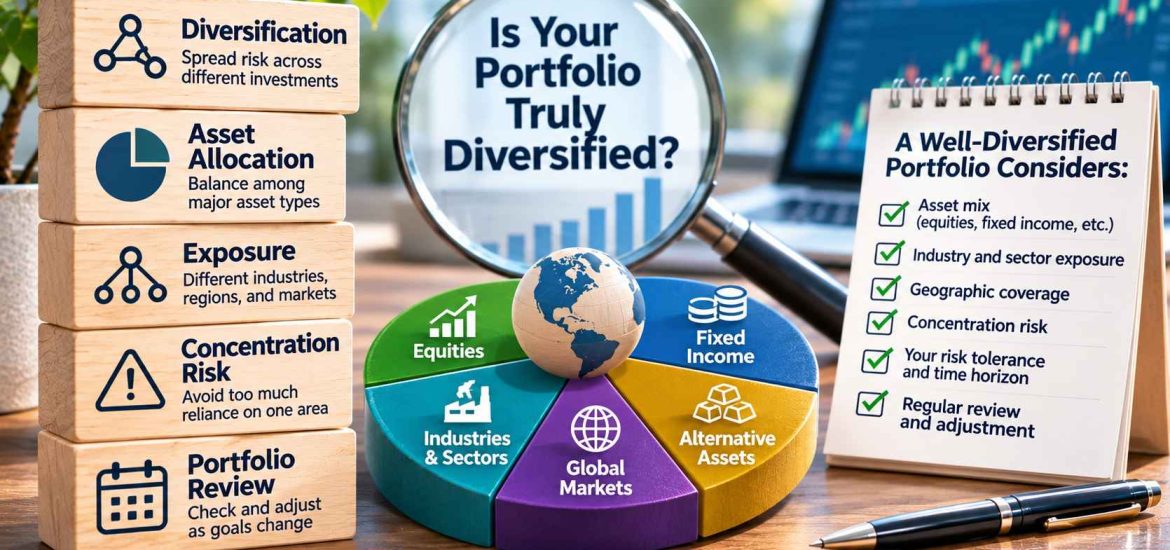
Imagine an investor who owns shares in several companies, holds multiple exchange-traded funds (ETFs), and maintains investments across different accounts. At first glance, the portfolio may appear well diversified because it contains numerous holdings.
However, a closer examination might reveal that many of those investments are concentrated in the same industries, markets, or companies.
This illustrates an important distinction: owning more investments does not automatically mean having a well-diversified portfolio.
Effective diversification involves understanding how investments relate to one another, what risks they share, and how different assets contribute to an overall financial strategy.
For Canadian investors, understanding these relationships can help make portfolio decisions more informed and less dependent on the number of investments owned.
What Does Investment Diversification Actually Mean?
Diversification is an investment strategy that involves spreading exposure across different assets to help manage risk.
Rather than depending entirely on one investment, company, industry, or market, investors distribute their holdings among investments with different characteristics.
For example, a portfolio concentrated entirely in one industry may be particularly vulnerable to developments affecting that sector.
A portfolio with exposure to several industries may be less dependent on any single industry’s performance.
However, diversification should not be confused with simply purchasing additional securities.
The important consideration is whether those investments introduce meaningful differences in risk exposure.
The U.S. Securities and Exchange Commission’s investor education resources on asset allocation and diversification explain how spreading investments across and within asset categories can help investors manage portfolio risk.
Diversification cannot eliminate the possibility of investment losses, but it remains an important principle of portfolio construction.
Understanding Asset Allocation Versus Diversification
Asset allocation and diversification are closely related concepts, but they describe different aspects of investing.
What Is Asset Allocation?
Asset allocation refers to how a portfolio is divided among major investment categories.
These categories commonly include:
- Equities, representing ownership in companies.
- Fixed-income investments, such as bonds.
- Cash and cash equivalents.
- Other asset categories, where appropriate.
Each category has different characteristics concerning risk, liquidity, and potential returns.
What Is Diversification?
Diversification considers how investment exposure is distributed both between and within these categories.
For example, an investor might allocate part of a portfolio to equities and another portion to fixed-income securities.
However, if the equity portion consists mainly of companies operating in one industry, that part of the portfolio may remain concentrated.
Effective portfolio construction requires considering both the asset allocation and the relationships among individual holdings.
Why Owning Multiple Funds May Not Create Meaningful Diversification
Investment funds can provide convenient access to numerous securities.
However, owning several funds does not necessarily mean holding substantially different investments.
Consider a hypothetical investor who owns a broad Canadian equity fund, a Canadian dividend fund, and a fund focused on Canadian financial companies.
Although these are three separate investments, they may hold many of the same businesses.
If the funds have significant exposure to similar companies, their performance could respond to some market developments in comparable ways.
This situation is known as portfolio overlap.
Looking Beneath Fund Names
Investors should examine the underlying holdings and investment objectives of their funds.
Two products with different names may follow similar strategies or hold overlapping securities.
The number of funds in a portfolio provides limited information without understanding what those funds actually own.
Understanding Exposure Across Different Industries
Industry diversification involves spreading investments across businesses operating in different economic sectors.
Examples include financial services, healthcare, technology, utilities, consumer products, and industrial businesses.
Different industries can respond differently to economic conditions.
For example, changes in interest rates may affect financial institutions and highly indebted businesses in different ways.
Similarly, changes in consumer spending can influence retailers differently from companies providing essential infrastructure services.
However, industry diversification is not a guarantee against losses.
During broad economic downturns, companies across several sectors may experience declining valuations simultaneously.
The objective is to avoid unnecessary dependence on one industry while recognizing that all investments remain exposed to certain risks.
Why Geographic Diversification Matters
Investors may also consider exposure to different countries and regions.
A portfolio invested exclusively in Canadian companies may be influenced by economic conditions, regulations, and industry concentrations within Canada.
International investments can introduce exposure to businesses operating in other markets.
However, geographic diversification involves more than identifying where a company is listed.
A Canadian company may generate substantial revenue internationally, while a foreign-listed business may depend heavily on customers in a particular country.
Investors should also consider currency exposure, political conditions, and differences in market structures.
Geographic diversification can broaden investment exposure, but it introduces additional considerations rather than removing risk altogether.
Why Different Investments Sometimes Move Together
One important concept in diversification is correlation.
Correlation describes the relationship between how investments move in value.
When two investments tend to rise and fall together, they have a positive correlation.
When their movements differ, combining them may offer greater diversification benefits, depending on the circumstances.
A Practical Example
Imagine an investor holding shares in several companies that depend heavily on similar economic conditions.
Although the companies are different, an industry-wide disruption could affect many of them simultaneously.
By contrast, businesses with different sources of revenue and operating environments may respond differently to certain events.
However, investment relationships are not fixed.
Assets that historically behaved differently may move in similar directions during periods of widespread market stress.
This is why diversification should be evaluated as an ongoing risk-management strategy rather than a permanent guarantee.
Recognizing Concentration Risk
Concentration risk occurs when a significant portion of a portfolio depends on a particular asset, company, industry, or other shared factor.
This risk can develop intentionally or unintentionally.
For example, a corporate executive may receive company shares as part of their compensation while also investing personal savings in the same business.
Their employment income and investment portfolio may then depend heavily on one company’s financial position.
Another investor may develop concentrated exposure because certain holdings have increased substantially in value.
Reviewing concentration involves understanding how much the portfolio relies on particular sources of risk.
Professional investment management can help investors consider portfolio structure, risk exposure, and investment objectives within a coordinated strategy.
How Risk Tolerance and Time Horizons Influence Diversification
The appropriate portfolio structure depends on individual circumstances.
Risk tolerance reflects an investor’s willingness to accept uncertainty and potential losses.
Risk capacity concerns their financial ability to withstand those losses.
Both should be considered alongside the investment time horizon.
For example, money intended for a near-term property purchase may require greater attention to liquidity and capital preservation.
Retirement savings intended for use many years later may support a different investment approach.
However, a longer time horizon does not automatically justify greater investment risk.
Personal obligations, income stability, future expenses, and emotional comfort with market fluctuations remain important.
Diversification should support these financial objectives rather than follow a universal formula.
Why Regular Portfolio Reviews Are Important
Portfolio composition can change even when an investor makes no new purchases.
Certain investments may grow faster than others, gradually increasing their share of the overall portfolio.
This can create unintended concentration.
For example, a portfolio initially spread across several industries may become increasingly dependent on one sector after a period of strong performance.
A comprehensive portfolio review can help examine asset allocation, overlapping holdings, concentration, fees, liquidity, and overall investment suitability.
Regular reviews also provide an opportunity to reconsider risk tolerance and financial objectives after major life changes.
However, reviewing a portfolio does not necessarily mean making frequent trades.
Sometimes, maintaining the existing strategy may remain appropriate.
Why Diversification Cannot Eliminate Every Investment Risk
Diversification helps manage certain risks, particularly those associated with individual investments or concentrated exposures.
However, broader risks can affect numerous assets simultaneously.
Economic recessions, inflation, interest rate changes, and major market disruptions may influence different investments at the same time.
Even diversified portfolios can experience significant declines.
Diversification should therefore be considered alongside liquidity planning, appropriate asset allocation, investment costs, and realistic expectations.
Investors should understand that reducing exposure to one particular risk does not eliminate all uncertainty.
Building a Portfolio With Meaningful Diversification
Effective diversification requires looking beyond how many investments appear on an account statement.
Investors should understand the companies, industries, geographic markets, and asset classes represented within their portfolios.
They should also consider how those investments behave under different conditions and whether their combined exposure aligns with personal financial goals.
A portfolio containing numerous overlapping holdings may be less diversified than it first appears.
Conversely, a carefully structured portfolio with fewer investment products may provide exposure to a broader range of underlying assets.
Ultimately, diversification is about the relationships between investments, not simply their quantity.
By reviewing portfolio composition, understanding concentration risk, and aligning investment decisions with individual circumstances, investors can approach long-term portfolio management with greater clarity and discipline.